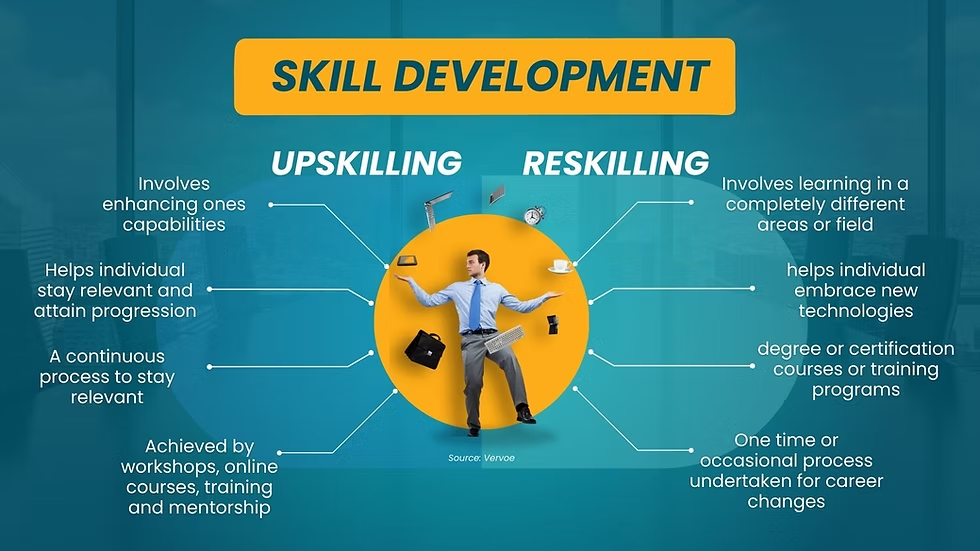
The era of “static competency” is over. In the high-velocity economy of 2026, the concept of “being qualified” has been replaced by the imperative of “staying relevant.” We are living through a period of Skill Compression, where the half-life of a learned technical skill has shrunk to fewer than 18 months. What was a cutting-edge advantage in 2024 is now a commoditized utility. To survive and thrive today, professionals must shift their mindset from “Education” (a finite phase) to “Enhancement” (a continuous operating system).
This guide is not just about learning new things; it is about optimizing and integrating the skills you already have to function in a world dominated by Agentic AI, decentralized teams, and rigorous performance metrics. Here is your blueprint for the relentless pursuit of professional excellence in 2026.
The Paradigm Shift: From “Acquisition” to “Integration”
In the early 2020s, upskilling was about acquiring distinct badges: a certificate in Python, a seminar on leadership. Today, value is created not by the isolation of these skills but by their integration. The highest-paid professionals are Polymaths—individuals who can synthesize technical fluency, creative intuition, and business acumen into a singular “M-Shaped” profile. Enhancement in 2026 is about blurring the lines: using code to improve your marketing, using psychology to improve your AI prompting, and using financial literacy to improve your design.
Mastering “Agentic AI” Orchestration
Moving Beyond Basic Prompting
“Prompt Engineering” was the skill of 2023. In 2026, the requirement is Agentic Orchestration. This involves managing autonomous AI agents that can plan, reason, and execute multi-step workflows. Skill enhancement here means learning how to configure “guardrails” for these agents, defining their permissions, and chaining them together to create a “digital workforce” that reports to you.
Context Engineering & Model Context Protocol (MCP)
To get reliable outputs from AI, you must master Context Engineering. This is the ability to structure data and instructions so that an AI model understands the specific nuance of your business environment. It involves learning the Model Context Protocol (MCP) to securely connect LLMs to your local files and databases, ensuring the AI “knows” what your company knows without hallucinating.
The Skill of “AI Audit”
As AI generates more of our code, copy, and strategy, the human ability to Audit becomes a premium skill. You must enhance your subject matter expertise to the point where you can instantly spot a subtle error in an AI-generated legal contract or a security vulnerability in synthetic code. You are no longer the writer; you are the Editor-in-Chief.
Cognitive Optimization & “Deep Thinking”
Attention Management as a Hard Skill
In an attention economy, the ability to focus is a competitive advantage. Skill enhancement involves training your Cognitive Endurance. This means practicing “Deep Work” intervals of 4 hours or more without switching tasks. Techniques like “Monk Mode” scheduling and digital fasting are no longer lifestyle choices but professional necessities to produce strategic breakthroughs.
Critical Thinking & Epistemic Humility
With the internet flooded with “Deepfakes” and synthetic content, Information Architecture—the ability to verify sources and structure valid arguments—is critical. You must cultivate Epistemic Humility: the discipline of actively seeking evidence that contradicts your beliefs to avoid confirmation bias in an algorithmic world.
The Art of “Unlearning”
The most difficult enhancement is removing obsolete software from your brain. Active Unlearning is the deliberate process of discarding habits that no longer serve you—such as “hustle culture” metrics (hours worked) in favor of “impact metrics” (outcomes achieved). It requires the psychological safety to admit that your previous expertise may now be a liability.
Data Fluency & Storytelling
From Analytics to Narrative
You do not need to be a Data Scientist, but you must be a Data Storyteller. Enhancement means moving beyond reading a dashboard to interpreting it. It involves using visualization tools (Tableau, Looker, or AI-generated charts) to weave raw numbers into a compelling business narrative that drives executive action.
Just-in-Time SQL & Python
While you may not code full-time, enhancing your literacy in SQL and Python allows you to query data directly without waiting for an analyst. This “Self-Service Analytics” capability dramatically increases your speed-to-insight, making you a more autonomous decision-maker.
The “Human Stack”: Emotional & Social Intelligence
Digital Body Language
In a hybrid world, you must enhance your Digital Presence. This involves mastering the subtle cues of remote communication: “Camera Eye Contact” (looking at the lens to simulate connection), using emojis to disambiguate tone in text, and mastering “Silence Discipline” (pausing to let audio lag catch up) during video calls.
Conflict Transformation
The ability to de-escalate tension is a “Power Skill.” Enhancement involves moving from “Conflict Resolution” (stopping the fight) to Conflict Transformation (using the friction to generate new ideas). Techniques like “Steel-manning”—articulating your opponent’s argument better than they did—build immense trust and pave the way for innovation.
Inclusive Leadership & Cultural Intelligence (CQ)
With global, distributed teams, you must enhance your Cultural Intelligence. This means understanding high-context vs. low-context communication styles. It involves “Code-Switching” your management style to suit the cultural norms of a team member in Tokyo versus one in Berlin, ensuring psychological safety for both.
Learning Methodology: How to Learn in 2026
Learning in the Flow of Work (LIFOW)
Stop waiting for “training days.” Enhancement happens in the Flow of Work. Use AI tutors and Augmented Reality (AR) overlays to get “Just-in-Time” information exactly when you need it. If you are stuck on a spreadsheet formula, an AI agent should guide you through it instantly, turning a friction point into a learning moment.
Micro-Learning & Spaced Repetition
Combat the “Forgetting Curve” with Micro-Learning. Consume educational content in 5-10 minute bursts daily rather than hour-long lectures. Use apps that leverage Spaced Repetition algorithms to resurface key concepts at optimal intervals, ensuring long-term retention of complex topics like compliance regulations or coding syntax.
Building a Personal Learning Network (PLN)
You cannot learn alone. Enhance your growth by curating a Personal Learning Network. This is a decentralized group of peers, mentors, and thought leaders—often found in niche Discords, DAOs, or newsletters—who act as your external brain, filtering signal from noise and keeping you ahead of trends.
Operational Skills for the Hybrid Age
Asynchronous Fluency
Enhance your ability to communicate without meetings. Asynchronous Fluency is the skill of writing clear, “Low-Context” documentation that allows a colleague in a different time zone to understand a project without asking you clarifying questions. It involves mastering video updates (Loom/Vimeo) to replace “status update” meetings.
Project Management for Non-PMs
Every role is now a project management role. Enhance your ability to use Agile and Kanban methodologies to manage your own workload. Understanding how to break massive goals into two-week sprints and visualize bottlenecks is essential for personal productivity in a fast-moving environment.
Sustainability & “Green Skills”
Carbon Literacy
The “Green Economy” is here. Enhance your Carbon Literacy—understanding how your job function impacts the planet. Whether it is minimizing digital waste (server load), sourcing sustainable materials, or calculating the carbon footprint of a logistics route, this is now a core operational metric.
Circular Economy Principles
Move beyond “linear” thinking (take-make-waste) to Circular Thinking. How can the output of your process become the input for another? Enhancing this skill helps you identify cost-saving opportunities and aligns your work with regulatory pressures like the EU’s Digital Product Passport.
Career Resilience & Personal Branding
The Portfolio Career Mindset
Stop viewing your career as a single track. Enhance your Portfolio Mindset. View your skills as assets that can be deployed in multiple ways: a full-time role, a fractional consulting gig, a paid newsletter, or an advisory board seat. This diversification creates financial anti-fragility.
Building in Public
In a noisy market, you must be discoverable. Enhance your Personal Brand by “Building in Public.” Share your learning journey, your failures, and your projects on platforms like LinkedIn or X. This creates a “Proof of Work” trail that attracts opportunities to you, reversing the traditional job search dynamic.
Conclusion: The Infinite Game
Skill enhancement in 2026 is not a destination; it is an Infinite Game. The goal is not to “finish” learning, but to stay in the game. The professionals who win this decade will be those who fall in love with the process of reinvention, who view every technological disruption not as a threat to their identity, but as an invitation to upgrade their operating system.